





What you’re feeling isn’t weakness, failure, or a personal unraveling. You’re not imagining it. It’s disruption – real, physiological, emotional disruption – and the menopause decline myth has done more harm than most people realize.
I want to be clear from the start: menopause is disruptive. It is not a disease. It is not a decline.
It’s a transition that shakes systems you’ve relied on for decades – hormones, sleep, stress tolerance, memory, mood, identity. When no one explains that properly, women assume something is wrong with them.
It isn’t.
This article exists to name what’s actually happening, unpack why culture keeps calling it “decline,” and show you a steadier way forward – without pretending this is easy or asking you to “think positive” before your nervous system has stabilized.
If you are interested in more, see Why Menopause Is Often Mislabelled as Decline
Menopause Isn’t a Decline. It’s a Disruption.
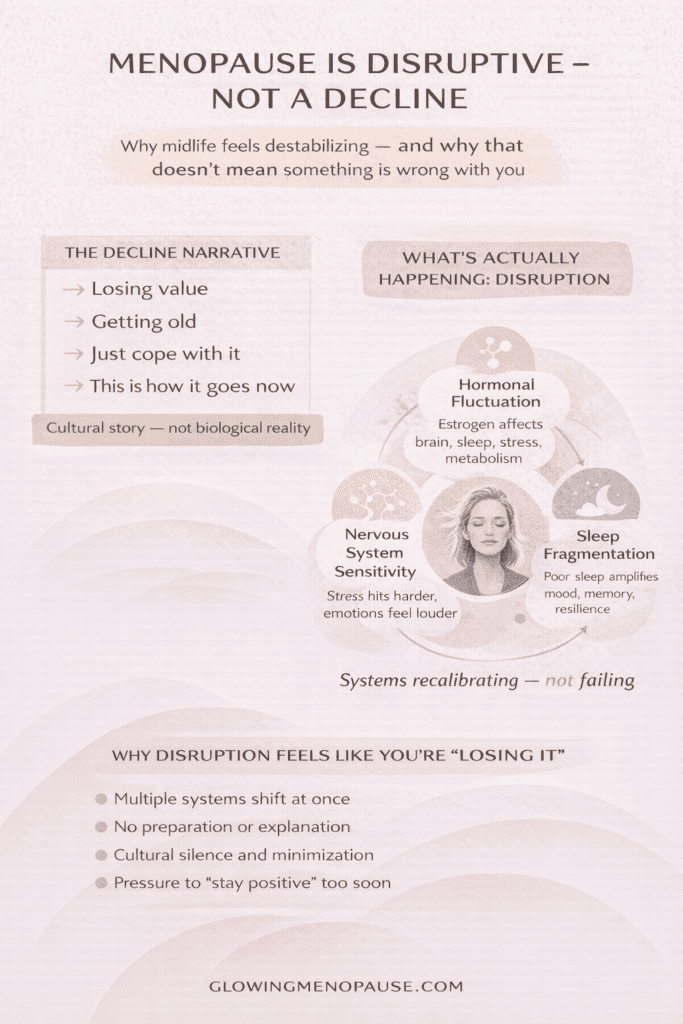
Decline implies loss of value.
Disruption implies a system under stress – temporarily destabilized, recalibrating.
Those two frames produce radically different experiences.
When menopause is framed as decline, women internalize it as:
- “I’m fading.”
- “I should be coping better.”
- “This is just aging – deal with it.”
When menopause is understood as disruption, something shifts:
- Symptoms make sense.
- Shame loosens.
- Relief becomes possible before reinvention.
This is the difference between pushing through and being supported through.
What “Disruption” Really Means in Midlife
The physiological and emotional shake-up
Estrogen doesn’t just regulate periods. It interacts with the brain, gut, immune system, cardiovascular system, and stress response. When levels fluctuate and drop, multiple systems lose their usual rhythm – often at the same time.
That’s why menopause disruption looks like:
- Sleep that falls apart even when you’re exhausted
- Anxiety that feels unfamiliar and unprovoked
- Brain fog that scares capable women
- Emotional reactivity you don’t recognize
- A body that no longer responds the way it used to
None of this means you’re “losing it.” It means your internal feedback loops are recalibrating.
Organizations like the Mayo Clinic and Cleveland Clinic describe menopause as a whole-body transition – not a single symptom, not a cosmetic issue, and not a character flaw.
Why disruption can coexist with growth
Disruption isn’t comfortable. But it is informative.
It reveals:
- Where stress tolerance has changed
- Where boundaries were already thin
- Where coping strategies no longer work
Growth doesn’t come from pretending this isn’t happening.
It comes from understanding it – then responding differently.
How the Decline Narrative Took Hold
From early medical texts to modern marketing
Historically, menopause was described in medical literature as deficiency. Women were defined by reproductive capacity; when that ended, the story followed.
Modern wellness culture didn’t fix this – it repackaged it.
Now the message sounds like:
- “Reverse aging”
- “Bounce back”
- “Get your body back”
- “Stay youthful”
Different packaging. Same implication: your value is slipping.
The harm in equating worth with youth and fertility
This belief system feeds menopause stigma and keeps women quiet.
If menopause equals decline, then symptoms feel like proof:
- Proof you’re less capable
- Proof you’re less attractive
- Proof you should step aside

Research cited by groups like The Menopause Society shows that unmanaged menopause symptoms directly impact confidence, career participation, and mental health – not because women are weaker, but because they’re unsupported.
That’s a systems failure, not a personal one.
For more on this, read How Beliefs About Aging Can Worsen Menopause Stress
Menopause Is a Reset, Not a Ruin
Brain, body, and emotional recalibration
Think reset, not replacement.
Your brain adapts to lower estrogen.
Your body adjusts to different metabolic signals.
Your emotions become more reactive before they stabilize.
This is why menopause transformation isn’t about becoming someone new overnight. It’s about restabilizing first.
The nervous system’s role in symptom experience
Here’s what rarely gets explained: menopause sensitizes the nervous system.
Lower estrogen affects:
- Cortisol regulation
- Sleep architecture
- Emotional filtering
So stress hits harder. Noise feels louder. Small problems feel overwhelming. This isn’t personality change – it’s physiology.
Psychology Today has repeatedly highlighted how hormonal shifts amplify stress perception, especially when women are already juggling work, caregiving, and identity transitions.
Why reframing matters for stress reduction
When symptoms are framed as decline, the nervous system stays on high alert.
When symptoms are explained as disruption:
- The threat response softens
- Self-blame decreases
- Regulation becomes possible
Understanding doesn’t fix everything – but it reduces the load.
Make sure you also read, Why Understanding Menopause Comes Before Rewriting It
When “Empowerment” Messaging Still Misses the Point
Why positivity before understanding backfires
Being told to “embrace this chapter” while you’re exhausted, foggy, and irritable doesn’t help. It alienates.
Empowerment without explanation feels like pressure:
- Pressure to feel grateful
- Pressure to reinvent
- Pressure to glow
That’s not support. That’s bypassing.
Grounded compassion vs. forced reinvention
Real menopause empowerment starts with:
- Naming symptoms honestly
- Explaining what’s happening
- Normalizing disruption
Only then does choice return.
You don’t need a glow-up.
You need clarity.
Disruption as an Invitation to Reassess, Not Regress
Identity redefinition and boundary setting
Menopause often collides with other shifts:
- Children leaving home
- Career reassessment
- Caregiving fatigue
Disruption exposes roles you’ve outgrown. Not because you failed – because time changed the equation.
This is where menopause and identity intersect. Not as loss; as recalibration.
Practical stabilizing steps for body and mind
Start here:
- Protect sleep like medicine
- Reduce unnecessary stress inputs
- Seek information that explains, not overwhelms
- Stop judging your capacity against your 35-year-old self
Relief comes before meaning. Always.
Real Women, Real Voices – The Relief of Naming It Honestly
“Once I understood this was hormonal disruption, not me losing control, my anxiety dropped by half.”
“Menopause didn’t break me. It showed me where I needed support.”
Stories like these are echoed across education platforms such as Let’s Talk Menopause. When women hear the truth, isolation dissolves.
How shared truth reduces isolation
Silence keeps women stuck. Shared language sets them free.
This is why community matters — not for hype, but for normalization.
Moving From Surviving to Understanding
Stabilize → Support → Strengthen
This isn’t about rushing to thrive. It’s about sequence.
Stabilize:
Name symptoms. Understand causes. Reduce self-doubt.
Support:
Introduce tools – education, routines, community – that ease the load.
Strengthen:
Build resilience after relief exists.
That’s how real menopause empowerment works.
Disruption Can Be Honest Without Being Hopeless
Menopause isn’t decline.
It’s not a personal failure.
And it’s not something to push through in silence.
It’s disruption – real, explainable, and manageable with the right support.
You don’t need to be positive about it.
You need to be believed.
When understanding comes first, peace follows – not because everything is fixed, but because nothing is mysterious anymore.