





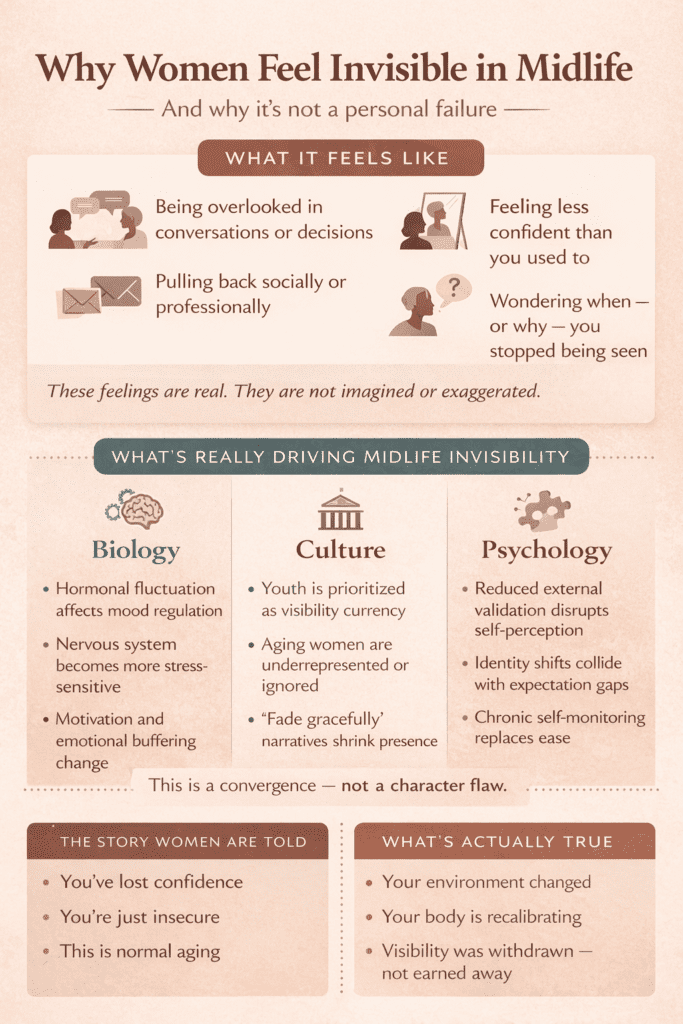
Feeling invisible in midlife doesn’t arrive quietly. It shows up in meetings where your ideas are skipped, in social spaces where attention slides past you, in mirrors that suddenly feel unfamiliar. It creeps in when you’re still capable, still sharp, still here – but treated like background noise.
I want to be clear, upfront: this is not you failing.
This is a collision between biology, culture, and long-standing myths about women and aging.
You’re not imagining it. You’re responding to a real shift that many women experience between 40 and 60 – and no one explained it properly.
“Visibility isn’t given – it’s reclaimed.”
You’re Not Imagining It: Midlife Invisibility Is Real
Women across workplaces, families, and social spaces report the same quiet shock: I’m still showing up, but I’m no longer being seen.
Research and lived experience align here. As women age, visibility often drops – not because contribution declines, but because cultural attention narrows. Youth is overvalued. Older women are flattened into stereotypes or erased altogether. Add menopause into the mix, and the internal experience can feel even more destabilizing.
This sense of being overlooked fuels self-doubt fast. You start questioning your confidence, your relevance, your worth. That’s not introspection. That’s pressure.
If this resonates, you’re not alone – and you’re not broken.
Related reading: Psychological research on midlife identity
Why Women Feel Invisible During Midlife
Hormonal changes and emotional recalibration
Midlife is not a static stage. It’s a neurological and hormonal recalibration.
Fluctuating estrogen affects mood regulation, emotional resilience, motivation, and stress tolerance. Many women feel less buffered against noise – emotional or literal. Confidence doesn’t disappear, but it becomes harder to access consistently.
When the inner ground shifts, external feedback matters more. And when that feedback dries up or turns dismissive, invisibility hits harder.
This is one reason the emotional impact of menopause is so often misunderstood or minimized – even though it’s well documented by sources like Harvard Health Publishing.
Societal conditioning that devalues aging women
We’re not taught to see aging women as expanding. We’re taught to see them as exiting.
Media representation drops off sharply after 45. Professional authority is quietly redirected toward younger faces. Even compliments shift from “You’re impressive” to “You look good for your age.”
That framing trains women to equate visibility with youth – and invisibility with failure. It’s not accidental. It’s cultural conditioning.
The psychological impact of cultural erasure
Humans calibrate identity through recognition. When recognition fades, self-perception wobbles.
This is why midlife invisibility often shows up as:
- Withdrawal
- Over-functioning (trying harder to be noticed)
- Or emotional numbing (“Why bother?”)
According to contributors in Psychology Today, long-term invisibility can quietly erode self-worth – especially when women internalize it as personal inadequacy instead of systemic bias.
Related reading: How aging affects women’s self-worth
The Myths That Make Invisibility Feel Like Failure
These myths don’t just exist – they actively shame women into silence.
“If you were confident enough, you wouldn’t feel unseen”
Confidence doesn’t operate in a vacuum. It’s shaped by feedback, context, and cultural reinforcement.
When systems stop reflecting your value back to you, even grounded women feel destabilized. That’s not weakness. That’s relational reality.
“You’re supposed to fade gracefully”
Graceful fading is a polite way of saying don’t take up space anymore.
It asks women to accept less voice, less presence, less ambition – without grief, anger, or resistance. That expectation alone creates shame around wanting to be seen again.
“It’s just part of getting older”
This phrase shuts conversations down fast.
Yes, bodies change. Hormones shift. But social dismissal is not a biological inevitability. It’s a choice society keeps making – and women keep paying for emotionally.
If this myth sounds familiar, it connects directly to what’s unpacked in Menopause Is Disruptive – Not a Decline, where disruption is named without moral judgment.
What’s Actually Happening – The Midlife Disruption
Menopause’s role in mood, motivation, and identity
Menopause isn’t just physical. It affects how women feel in their own skin – emotionally and socially.
Changes in neurotransmitter sensitivity can dull motivation temporarily. That doesn’t mean desire is gone. It means the nervous system is recalibrating.
This period often overlaps with other identity shifts: children leaving home, career plateaus or pivots, caregiving roles increasing. The internal question “Who am I now?” gets louder.
Related reading: Hormonal changes during menopause
How body changes collide with external expectations
When bodies change in a culture obsessed with youth, women feel watched and ignored at the same time.
You’re visible as an object of scrutiny, but invisible as a person with authority and depth. That contradiction is exhausting.
Emotional and social factors amplifying invisibility
Isolation compounds invisibility. When women don’t talk openly about these shifts – often because no one around them is – the experience feels uniquely personal.
That silence is one reason platforms like Let’s Talk Menopause matter. Shared language reduces shame.

How to Reclaim Your Visibility Without Chasing Validation
Reclaiming visibility is not about performing louder or competing with youth. It’s about recalibrating where worth comes from.
Redefine worth beyond looks and productivity
If worth is tied to appearance or output, midlife feels like loss. When worth is tied to discernment, presence, and experience, midlife becomes solid.
That shift isn’t theoretical. It’s practical protection against cultural erasure.
Find or build spaces that mirror your value
Visibility grows where reflection exists.
That might be:
- Peer communities
- Creative circles
- Purpose-driven work
- Conversations that don’t require shrinking
If a space consistently makes you feel smaller, it’s not neutral. It’s misaligned.
Set boundaries with narratives that shrink you
You don’t have to argue with every dismissive comment – but you do get to stop internalizing them.
This boundary-setting connects directly to How Beliefs About Aging Can Worsen Menopause Stress, where outdated narratives quietly magnify distress.
Real Women, Real Stories – Reclaiming Midlife Presence
Voices from the Glowing Menopause community
One woman described it this way:
“I thought I was losing confidence. Turns out I was losing mirrors.”
Another shared:
“Once I stopped waiting to be acknowledged and started choosing where I showed up, everything shifted.”
These aren’t transformations. They’re recalibrations.
Expert insight on reclaiming self-perception
Clinicians and therapists increasingly recognize that midlife invisibility is not pathology. It’s context.
When women understand why they feel unseen, self-blame drops. Agency returns. According to experts cited through Harvard Health Publishing, clarity itself is stabilizing.
Actionable Tools to Feel Seen Again
Daily grounding and self-recognition practices
- Name what you notice – without fixing it.
- Track moments where you do feel engaged or respected.
- Reduce self-criticism before increasing self-improvement.
Stability comes first. Meaning follows.
Reconnection through community and creativity
Creativity isn’t about output. It’s about presence.
Anything that brings you back into your body and voice – writing, movement, learning – counters invisibility internally, even before it changes externally.
Professional or group support for midlife confidence
Coaching, therapy, or facilitated groups can provide structured reflection when identity feels diffuse.
If you’re exploring mindset support, the Menopause Mindset Shift guide is designed as a stabilizing resource – not a motivational push.
Invisibility Isn’t Who You Are, It’s What You’ve Been Told to Be
Feeling invisible in midlife doesn’t mean you disappeared.
It means the lens is outdated.
You’re not fading. You’re evolving – and the world hasn’t adjusted its focus yet.
That gap is uncomfortable. But it’s not permanent. And it’s not a verdict on your worth.
“Midlife doesn’t erase you; it refines your presence.”
If this article helped you feel a little more grounded, you’re welcome to join the Glowing Menopause newsletter – a space built to explain, steady, and support women through this phase without minimizing or glossing over it.