





Midlife myths don’t just confuse women – they quietly raise the bar on suffering.
Somewhere between our 40s and 60s, many women start carrying a sense that they’re behind, failing, or doing midlife “wrong.” Not because anything is actually wrong – but because the cultural stories surrounding midlife are distorted, incomplete, and relentlessly unrealistic.
The pressure doesn’t come from our bodies alone. It comes from the beliefs we’ve absorbed about aging, productivity, worth, and what we should look like by now.
This article breaks down the most common midlife myths – not to reframe your life or push reinvention, but to remove unnecessary weight from a stage of life that’s already demanding enough.
If midlife feels heavier than expected, it’s often because you’re carrying expectations that were never designed to fit real women.
Why Midlife Feels Heavier Than It Should
Midlife often arrives alongside real disruptions: hormonal shifts, sleep problems, cognitive changes, caregiving pressure, shifting identities, and health uncertainty. That alone is a lot.
But layered on top of those realities are expectations:
- That you should be calm and grateful
- That you should have everything figured out
- That struggle means failure rather than transition
When these beliefs go unchallenged, midlife becomes emotionally exhausting – not because it’s inherently bleak, but because women are asked to cope quietly while performing competence.
This pattern mirrors what we see repeatedly in menopause narratives, where symptoms are minimized or reframed too quickly instead of being explained. If this sounds familiar, it’s explored more deeply in Why Menopause Messaging Often Misses Women’s Real Needs.
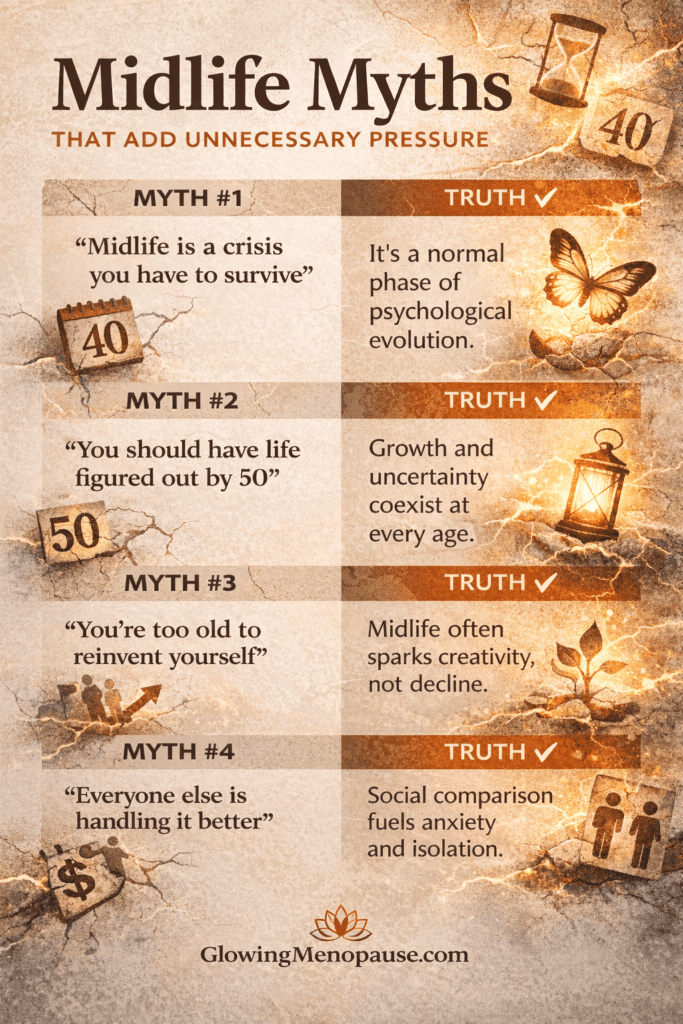
Myth #1: “Midlife Is a Crisis You Have to Survive”
The phrase midlife crisis has done lasting damage.
It frames midlife as a psychological emergency rather than what it usually is: a period of reassessment triggered by real biological, social, and role-based changes.
Truth: It’s a Normal Phase of Psychological Evolution
Research in adult development shows that midlife often coincides with:
- Hormonal fluctuation
- Increased emotional sensitivity
- Heightened awareness of time, limits, and mortality
- Shifts in identity as caregiving and career roles change
None of this implies pathology.
Labeling normal disruption as “crisis” pushes women toward shame and silence instead of understanding. This same mislabeling happens frequently during menopause, where symptoms are dismissed as stress or mood rather than physiology – a pattern unpacked in Menopause Is Disruptive – Not a Decline.
Myth #2: “You Should Have Life Figured Out by 50”
This myth is particularly cruel because it assumes life unfolds linearly.
It suggests that uncertainty in midlife is evidence of failure – rather than a sign that conditions have changed.
Truth: Growth and Uncertainty Coexist at Every Age
By midlife, many women are:
- Re-evaluating careers that no longer fit
- Adjusting to empty nests or caregiving roles
- Managing bodies that don’t respond the way they used to
- Processing grief, loss, or delayed dreams
Expecting clarity without recalibration ignores how much the internal and external landscape shifts during this period.
If you’ve felt destabilized rather than “settled,” you’re not alone. That experience is explored further in Midlife Isn’t a Crisis – But It Can Feel Destabilizing.
Myth #3: “You’re Too Old to Reinvent Yourself”
This myth doesn’t just discourage change – it prevents adaptation.
Women are often told they’ve missed their window for creativity, learning, or starting something new, especially if they didn’t “reinvent” earlier.
Truth: Midlife Often Sparks Creativity, Not Decline
Many women report increased clarity about:
- What no longer works
- What they’re unwilling to tolerate
- Where their energy is worth spending
That clarity can feel uncomfortable before it feels useful. It’s not reinvention for its own sake – it’s adjustment based on lived experience.
Problems arise when cultural narratives push reinvention before stabilization. This pressure is similar to what we see in menopause content that urges mindset shifts before symptoms are understood, a tension addressed in Why Understanding Menopause Comes Before “Rewriting” It.
Myth #4: “Everyone Else Is Handling It Better”
This belief thrives on silence.
Because midlife struggles – especially around menopause, mental health, libido, or identity – are still under-discussed, many women assume they’re alone in their difficulty.
Truth: Social Comparison Fuels Anxiety and Isolation
What we see publicly is often:
- Curated resilience
- Filtered wellness
- Quiet suffering framed as competence
Social comparison doesn’t motivate here – it isolates.
The feeling of being the only one struggling is one of the most common emotional experiences reported by midlife women, particularly during menopause. That invisibility is explored further in Feeling Invisible in Midlife Is Common – and Not a Personal Failure.
Myth #5: “Midlife Is About Losing Value”
This is the myth underneath all the others.
It equates worth with youth, productivity, sexual availability, or constant output – metrics that naturally shift over time.
Truth: Value Shifts, It Doesn’t Disappear
Midlife often brings:
- Greater discernment
- Stronger boundaries
- Deeper self-knowledge
- Less tolerance for noise and performance
But when worth is still measured using outdated standards, women internalize the idea that they are “less than” – even when they are more capable, skilled, and experienced than ever.
This belief intersects heavily with menopause stigma and ageism, which is examined in Inherited Beliefs About Menopause – and How They Shape Expectations.
Why These Myths Persist
Cultural Obsession With Youth and Productivity
Modern culture values speed, novelty, and visibility. Midlife, by contrast, often involves slowing down, reassessing, and turning inward – none of which are rewarded socially.
Marketing Narratives That Exploit Insecurity
From “anti-aging” messaging to glow-up culture, many industries profit from positioning midlife as a problem to be fixed rather than a phase to be understood.
These narratives don’t just sell products – they amplify pressure.
The Emotional Cost of Believing Midlife Myths
When these myths go unchallenged, women often report:
- Chronic self-doubt
- Emotional exhaustion
- A sense of invisibility
- Shame for not coping “better”
The most damaging part of midlife myths isn’t the belief itself – it’s the silence they create.
This mirrors the emotional impact seen when menopause symptoms are minimized or misdiagnosed, a topic explored in Menopause Misdiagnosis: Why Symptoms Are Often Missed or Minimized
Reframing Midlife – A Realistic and Compassionate Approach
Reframing doesn’t mean forcing positivity.
It means:
- Naming what’s happening
- Understanding why it’s happening
- Reducing unnecessary self-blame
Validation First, Transformation Later
Relief comes before meaning. Stability comes before growth.
Defining Worth Through Lived Experience
Midlife asks different questions than earlier life stages. The answers don’t need to look impressive – they need to feel true and sustainable.
This shift in perspective is central to Menopause Mindset Shift: Why It’s Not “All in Your Head”
Practical Ways to Reduce Midlife Pressure
Set Boundaries With Cultural Noise
You are not required to consume narratives that make you feel behind, broken, or invisible.
Practice Evidence-Based Self-Compassion
Self-compassion isn’t indulgence. It’s a proven buffer against anxiety, burnout, and depression.
Engage in Supportive Communities
Isolation amplifies pressure. Shared understanding reduces it.
If you’re looking for grounded, evidence-based support around menopause and midlife stress, you may find value in exploring the Glowing Menopause community.
Living Midlife Without the Myths
Midlife isn’t meant to be performed, conquered, or rushed through.
Much of the pressure women feel comes not from their bodies or choices – but from myths that were never meant to fit real lives.
Letting go of those myths doesn’t require reinvention. It requires understanding, permission, and support.
You don’t need to rise, glow, or reinvent to be doing midlife “right.” You need space to understand what’s actually happening – and help that respects it.