





Menopause dismissal doesn’t happen because symptoms are mild.
It happens because they belong to women.
If you’ve ever been told your symptoms are “just stress,” “normal aging,” or “in your head,” you already know this isn’t abstract. It’s personal. You show up asking for help, and you leave doubting yourself. I’ve heard it from women who trust their bodies, track their health, advocate clearly – and still get brushed off.
This isn’t a communication problem. It’s a structural one.
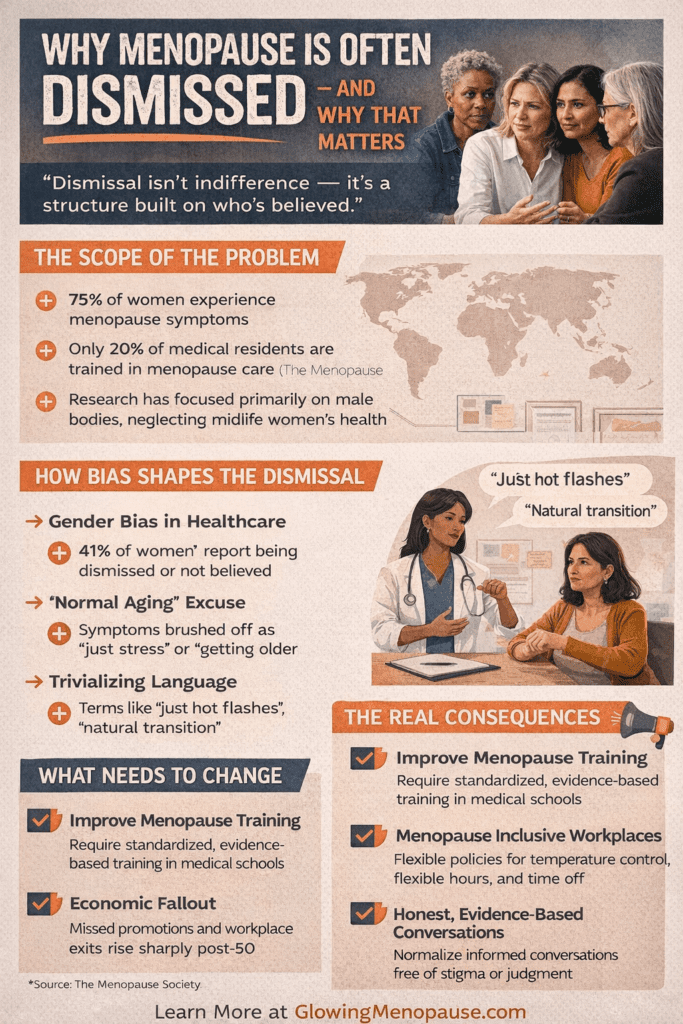
“Dismissal isn’t indifference – it’s a structure built on who’s believed.”
The Persistent Dismissal of Menopause
Menopause affects every woman who lives long enough. Yet menopause dismissal remains baked into healthcare systems, workplace norms, and cultural narratives. That contradiction should stop us cold.
Instead, we normalize it.
You’re expected to cope quietly. To keep working. To keep caring. To keep performing. And when symptoms interfere – brain fog, panic, insomnia, pain – the burden shifts back to you to “manage better.”
This article names what’s actually happening. Not to inflame. To clarify.
The Scope of the Problem
A global health gap hiding in plain sight
Menopause is not rare. It’s not niche. It’s not optional.
And yet, globally, menopause care is fragmented, underfunded, and inconsistently taught. Many medical professionals receive minimal formal training in menopause across their entire education. Women report seeing multiple clinicians before menopause is even raised as a possibility.
Major institutions acknowledge this gap. Organizations like The Menopause Society have repeatedly called attention to inadequate education and delayed diagnosis.
The problem isn’t that information doesn’t exist.
It’s that it hasn’t been prioritized.
Why menopause still isn’t a medical priority
Medical research has historically centered male bodies as the default. Women’s health has been treated as a “special interest” – reproductive years prioritized, midlife ignored.
Menopause falls into an uncomfortable gap:
- It isn’t a disease.
- It isn’t fertility.
- It doesn’t neatly fit pharmaceutical pipelines.
So it gets sidelined.
Even global bodies like the World Health Organization acknowledge disparities in women’s midlife care – but policy change moves slowly. Meanwhile, women keep showing up with symptoms that don’t fit tidy boxes.
How the Dismissal Takes Shape
Gender bias in medicine and research
Gender bias in healthcare isn’t subtle. It shows up in whose pain is believed, whose symptoms are investigated, and whose complaints are minimized.
Women are more likely to be told symptoms are psychological. More likely to be prescribed antidepressants before hormonal explanations are explored. More likely to be reassured instead of assessed.
This isn’t accidental. It’s systemic.
Research published and discussed by the American Psychological Association highlights how women’s physical symptoms are routinely reframed as emotional distress – especially in midlife.
Menopause sits right in that crossfire.
The cultural habit of minimizing women’s pain
Culturally, women’s suffering has always been expected to be quiet, resilient, and invisible.
Periods? Normalize the pain.
Childbirth? Endure it.
Menopause? Don’t talk about it.
The message is consistent: discomfort is part of womanhood. Complaints are exaggeration. Strength means silence.
When menopause symptoms escalate – rage, panic, dissociation, exhaustion – they clash with expectations. So they’re discounted.
“When menopause is minimized, women are too.”
Language that trivializes real experiences
Words matter. And the language around menopause is loaded with dismissal.
- “Just hot flashes.”
- “A natural transition.”
- “Nothing abnormal.”
None of that helps when your sleep is broken, your cognition feels unreliable, and your body no longer responds the way it used to.
Neutral language becomes harmful when it’s used to shut down inquiry.

The Real-World Consequences
Misdiagnosis and untreated symptoms
Menopause dismissal doesn’t stay theoretical. It leads directly to missed or delayed care.
Women are treated for anxiety instead of hormonal fluctuation. For depression instead of neurological effects. For stress instead of endocrine disruption.
If you want a deeper dive into how often this happens – and why – read Menopause Misdiagnosis: Why Symptoms Are Often Missed or Minimized.
That piece breaks down the patterns clinicians rarely name.
Impact on mental health and relationships
When symptoms are dismissed, self-trust erodes.
You start wondering if you’re overreacting. If you’re weak. If you should just push harder.
That internalized doubt strains relationships. Partners don’t understand what you can’t explain. Colleagues notice changes you can’t control. Emotional volatility becomes shame instead of information.
The psychological toll compounds the physical one.
Economic and professional fallout
Menopause dismissal also costs women professionally.
Reduced productivity. Missed promotions. Career exits at peak experience. Workplace cultures rarely accommodate menopause-related needs – because they’re barely acknowledged.
This isn’t a personal failure. It’s a systemic leak of talent.
Why Awareness Alone Isn’t Enough
The gap between recognition and reform
Menopause is finally getting media attention. Celebrities talk. Headlines appear. Awareness campaigns launch.
And yet, in exam rooms and HR offices, little changes.
Recognition without reform becomes performance. It validates without supporting. It names without fixing.
Media narratives that still miss the mark
Too much coverage frames menopause as either:
- A punchline
- Or a “reinvention opportunity”
Both miss the point.
Women don’t need menopause to be inspirational. They need it to be taken seriously.
What Needs to Change
Education for healthcare providers
Menopause education must be standardized, mandatory, and evidence-based across medical training.
Clinicians shouldn’t rely on outdated frameworks or personal interest to become menopause-literate. This is basic care.
Organizations like Harvard Health Publishing have published clear guidance – but it needs to reach practice, not just print.
Workplace inclusion and menopause-friendly policies
Workplaces already adapt for pregnancy, disability, and mental health. Menopause deserves the same structural support.
Flexible scheduling. Temperature control. Leave policies. Training for managers.
These aren’t perks. They’re retention strategies.
Normalizing honest, evidence-based conversations
Menopause conversations need to move out of whispers and into reality.
Not dramatized. Not minimized. Just named.
Take the next step toward real support
If you’re looking for menopause education and advocacy resources that go beyond surface awareness, explore platforms that focus on evidence, access, and reform – not quick fixes.
The Role of Advocacy and Community
How collective voices drive systemic change
Change doesn’t start in silence. It starts when patterns are named – together.
Menopause advocacy has already driven progress in countries adopting workplace guidelines and public health initiatives. But momentum depends on collective pressure.
No one should have to fight alone.
Organizations leading the movement
Groups like The Menopause Society and British Menopause Society are pushing education, research, and policy forward. Their work matters – and so does public engagement with it.
How You Can Advocate for Yourself
Documenting experiences and demanding better care
Write symptoms down. Track patterns. Bring data. Not because you should have to – but because systems still respond to documentation.
You are not being difficult. You are being precise.
Choosing menopause-informed practitioners
Not every provider is trained in menopause care. Seek those who are. Ask directly about experience and approach.
You deserve informed attention.
Joining advocacy networks or campaigns
Community creates leverage. Shared stories create evidence. Collective demand creates reform.
Dismissal Has Consequences. So Does Awareness.
Menopause dismissal isn’t about ignorance. It’s about value.
Whose pain counts. Whose disruption matters. Whose bodies deserve investment.
Awareness alone won’t fix that. But informed pressure can.
If you want grounded, ongoing insight – not platitudes – join the Glowing Menopause community. You’ll get education, advocacy updates, and resources designed to make you feel believed before you’re ever asked to feel hopeful.