






Emotional swings during menopause don’t come with warning labels. One moment you’re fine. The next, your chest feels tight, your thoughts race, and tears appear out of nowhere. These menopause emotional symptoms can feel sudden, overwhelming, and deeply unsettling, especially if you’ve always been the steady one.
If you’ve found yourself thinking, “Why am I reacting like this?” or “I don’t recognize myself,” hear this clearly: your emotions aren’t overreactions. They’re signals from a system in flux. And there are ways to calm the spiral, starting with what helps first.
When Emotions Feel Bigger Than You
I’ve spoken to countless women who describe the same moment: the emotional drop. It might be triggered by a small comment, a work email, or nothing obvious at all. Suddenly there’s anxiety, irritability, sadness, or a sense of panic that feels out of proportion, and impossible to shut off.
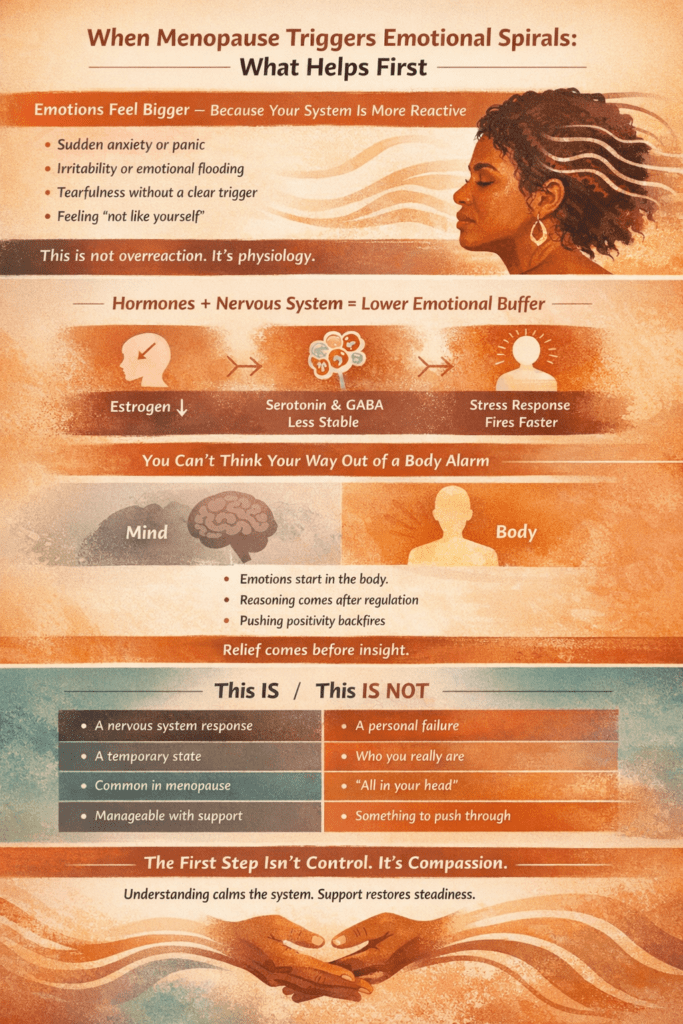
This isn’t a personal failing. It’s a physiological response. During perimenopause and menopause, hormonal shifts can amplify emotional reactions, narrow stress tolerance, and make it harder to self-regulate in the moment. That’s why menopause emotional symptoms often feel so intense and confusing.
Before you try to fix your mindset, build resilience, or “think positive,” your nervous system needs steadiness. Let’s start there.
“An emotional spiral isn’t a breakdown – it’s a body asking to be understood.”
Why Menopause Can Trigger Emotional Spirals
The hormonal–brain connection (estrogen and serotonin)
Estrogen isn’t just a reproductive hormone. It plays a direct role in brain chemistry – especially serotonin, dopamine, and GABA, which influence mood, motivation, and calm. When estrogen fluctuates (rather than declines smoothly), those systems lose stability.
Research summarized by The Menopause Society shows that these fluctuations can heighten vulnerability to mood changes, anxiety, and depressive symptoms – particularly during perimenopause, when hormones swing unpredictably.
Why emotional resilience dips temporarily
Emotional resilience relies on consistent internal signals. Menopause disrupts that consistency. The brain’s threat-detection system becomes more reactive, while the “brakes” that help you pause and regulate can lag behind. That’s why menopause mood swings can feel sharp and sudden.
How external stress compounds internal change
Midlife rarely happens in a vacuum. Career pressure, caregiving, sleep disruption, health worries, and identity shifts all add load. When hormonal buffering drops, stress that once felt manageable can tip you into an emotional spiral faster than before.
Understanding What’s Happening in Your Body
The science of estrogen’s effect on mood and cognition
Estrogen supports blood flow and signaling in areas of the brain involved in emotion and memory. As levels fluctuate, some women experience brain fog alongside mood changes. Harvard Health Publishing explains that this isn’t imagination, it’s biology affecting cognition and emotional processing together.
The role of cortisol and nervous system reactivity
Cortisol, the primary stress hormone, becomes more influential when estrogen’s calming effect wanes. The nervous system shifts toward vigilance. This makes menopause anxiety more likely, even in women with no prior history of anxiety.
Emotional dysregulation as a biological stress signal
Emotional dysregulation isn’t weakness. It’s a sign that your system is overloaded and asking for support. According to American Psychological Association, hormonal transitions can lower the threshold for emotional regulation, especially when combined with sleep loss or chronic stress.
What Helps First – Before You Try to “Fix” Everything
When emotions spike, logic usually fails. Regulation starts in the body.
Step 1: Ground your body before your thoughts
Sit or stand with your feet firmly planted. Press your toes into the floor. Notice weight and contact. This sends a signal of safety to the nervous system.
Step 2: Name what’s happening without judgment
Silently say: “This is an emotional surge. It will pass.” Naming reduces threat response. It’s a core technique used in trauma-informed care and supported by clinicians writing for Psychology Today.
Step 3: Regulate breath, temperature, and sensory input
Slow exhalations calm the vagus nerve. Cooling the face or wrists can reduce physiological arousal. Dimming lights or stepping outside helps reset sensory overload.
Step 4: Reconnect to safety through stillness or movement
Some bodies need stillness. Others need gentle movement – a short walk, stretching, or rocking. Choose what brings relief, not what looks productive.
“The first step out of overwhelm isn’t logic. It’s kindness.”
If you’re ready to move beyond survival mode, read Moving From Coping to Stability During Menopause to learn how to build steadiness over time.
Rebuilding Emotional Stability Over Time
Establishing daily emotional hygiene
Think of emotional hygiene like brushing your teeth. Small, regular practices – sleep protection, nourishment, movement, quiet – prevent spirals from building.
Journaling and tracking mood triggers
Tracking patterns helps you anticipate vulnerable windows. Hormonal cycles, sleep debt, and stress clusters often explain why symptoms surge when they do.
The difference between self-regulation and suppression
Self-regulation allows emotions to move through safely. Suppression pushes them down, often leading to stronger rebounds later. Mayo Clinic notes that acknowledging emotional shifts improves long-term mental health outcomes during menopause.

When Professional Support Helps
How to know when emotional spirals need therapy
If emotional episodes interfere with work, relationships, or self-care – or include panic, despair, or numbness – it’s time to reach out. Therapy isn’t a failure; it’s support during a neurobiological transition.
The value of menopause-informed mental health care
Not all providers understand menopause. Seek clinicians familiar with hormonal transitions. The Menopause Society offers practitioner directories and education resources.
Hormone, lifestyle, and psychological integration
The most effective support often combines approaches: medical evaluation, therapy, and practical nervous system regulation.
What Partners, Friends, and Family Can Do
Understanding over fixing
Listening without solutions builds safety. Emotional spirals calm faster when women feel believed.
Communication tips for emotional safety
Ask: “What do you need right now?” Avoid minimizing or reframing.
Supporting without minimizing
Statements like “It makes sense you feel this way” matter more than advice.
Real Voices : Women Who Found Their First Calm
Anna, 52: “Once I stopped fighting the feelings and focused on calming my body first, the panic lost its grip.”
Lerato, 47: “Tracking my sleep and stress showed me patterns. I wasn’t ‘losing it’, my system was overloaded.”
Maya, 58: “Therapy with someone who understood menopause changed everything. I finally felt heard.”
Shared truth: relief begins with understanding, not control.
The First Step Isn’t Control, It’s Compassion
Menopause can magnify emotions, but it doesn’t erase your strength. Menopause emotional symptoms are common, explainable, and manageable with the right support. Start with kindness. Start with steadiness. And remember: you don’t have to navigate this alone.