






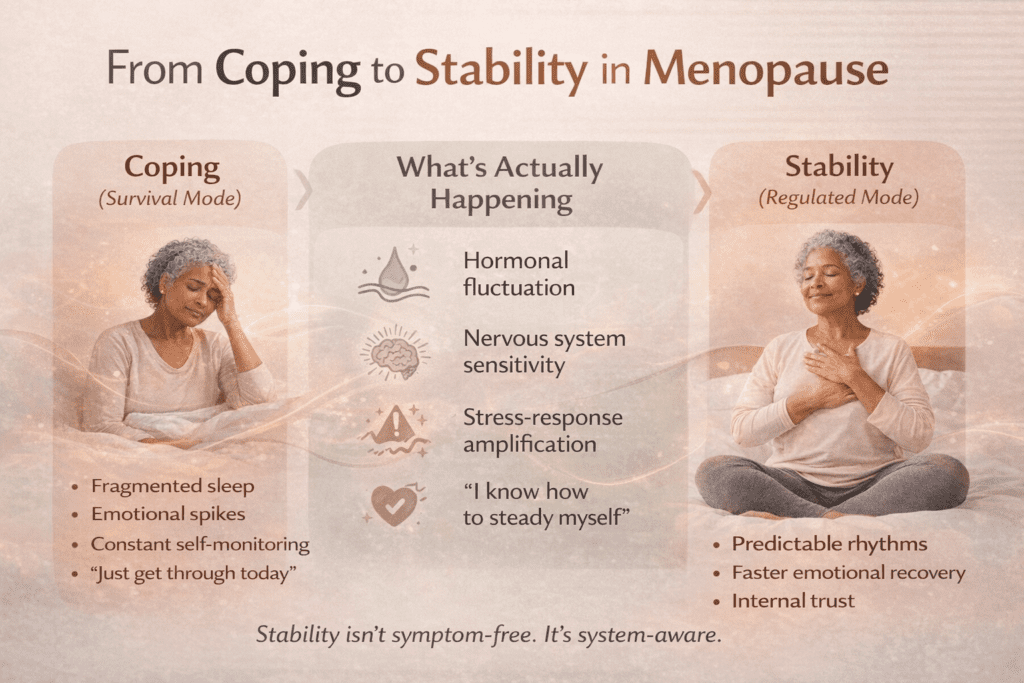
Menopause doesn’t just add symptoms. It destabilizes rhythm, mood, sleep, and confidence all at once. Most advice around coping with menopause assumes you’re meant to endure it – manage flare-ups, push through bad days, wait it out. That framing keeps you in survival mode as it does not bring stability during menopause.
Coping is not the goal.
Stability is.
Stability means you’re no longer bracing for impact every morning. Your nervous system isn’t constantly on edge. You can trust your body again – even if it’s still changing.
“Stability doesn’t mean you never wobble – it means you know how to steady yourself.”
Coping Isn’t Enough: Stability Is the Goal
Coping keeps you afloat. Stability lets you stand.
When menopause hits, many women do everything “right” – supplements, meditation apps, exercise tweaks – yet still feel emotionally off-balance. The problem isn’t effort. It’s that coping strategies are reactive by design. They chase symptoms after the fact.
Stability is proactive. It’s about creating conditions where your system feels safe enough to regulate itself.
That shift matters more than any single intervention.
Why Menopause Feels So Unstable
Hormonal fluctuations and brain chemistry changes
Estrogen doesn’t just affect reproduction. It influences serotonin, dopamine, cortisol, and how your brain processes stress. As levels fluctuate, emotional regulation becomes harder. Mood swings, anxiety, irritability, and brain fog often show up before classic physical symptoms.
Mayo Clinic explains that changing estrogen levels can directly impact mood, sleep, and cognitive function – not because something is “wrong,” but because the brain is adapting to a new hormonal environment.
The stress response gets louder
Lower estrogen makes the nervous system more reactive. Cortisol spikes faster. Recovery takes longer. Everyday stressors feel heavier than they used to, even when nothing dramatic has changed.
Harvard Health notes that menopause can amplify stress sensitivity, contributing to sleep disruption and emotional volatility.
Societal pressure to appear “fine”
You’re expected to function normally while your internal landscape is shifting. That mismatch creates self-doubt. Many women minimize their experience or push harder instead of slowing down – which only increases instability.
If this resonates, the pattern is explored further in How Beliefs About Aging Can Worsen Menopause Stress.

The Coping Trap – Managing Without Healing
Survival mode becomes the default
When symptoms feel unpredictable, you start monitoring yourself constantly: How am I feeling? Is this a hot flash? Am I about to snap? That vigilance keeps the nervous system activated.
Constant self-monitoring fuels anxiety
Tracking every symptom without context can backfire. Awareness without regulation increases tension. Your body stays on alert instead of settling.
“Doing more” leads to burnout
Adding more routines, more rules, more supplements can become another stressor. If your system is already overwhelmed, piling on fixes won’t create calm.
This is where many women get stuck – functioning, but never steady.
“You’ve spent years coping. Now it’s time to feel secure again.”
What Stability Really Means in Menopause
Emotional grounding, not symptom control
Stability doesn’t require eliminating every symptom. It means your reactions soften. You recover faster. Bad days don’t derail your sense of self.
Recognizing signals early
Instead of being blindsided by overwhelm, you start noticing subtle cues – tension, fatigue, irritability – and responding before they escalate.
Defining your version of calm
Stability is personal. For some, it’s better sleep. For others, fewer emotional swings or clearer thinking. The point is consistency, not perfection.
This reframing aligns with Menopause Is Disruptive – Not a Decline.
The Path From Coping to Stability
Step 1: Identify your stress loops
Notice what keeps cycling:
- Poor sleep → anxiety → poor sleep
- Overcommitment → exhaustion → irritability
- Restrictive routines → rebound stress
Naming these loops is stabilizing in itself. It shifts blame from you to the pattern.
Step 2: Rebuild rhythm through sleep, nutrition, and movement
Stability depends on rhythm. Irregular sleep and blood sugar swings make emotional regulation harder.
Evidence-based guidance from The Menopause Society emphasizes sleep consistency, balanced nutrition, and gentle movement as foundational supports during menopause.
You’re not chasing optimization. You’re restoring predictability.
Step 3: Redefine self-care as self-regulation
Self-care isn’t indulgence. It’s nervous system hygiene.
- Breathing before reacting
- Eating regularly
- Saying no sooner
These choices stabilize internal signals your body relies on to feel safe.
Step 4: Strengthen emotional safety and support
Isolation increases stress. Validation reduces it.
Research summarized by Psychology Today shows that perceived support lowers cortisol and improves emotional resilience – especially during life transitions.
If you’ve felt unseen, Feeling Invisible in Midlife Is Common – and Not a Personal Failure addresses this directly.
Tools That Foster Consistency and Calm
Journaling prompts for regulation
Instead of symptom logs, try:
- What helped me feel steadier today?
- Where did I push past my limits?
- What felt supportive rather than demanding?
Breathwork and grounding
Slow exhalations activate the parasympathetic nervous system. Even two minutes can shift your baseline.
Cognitive reframing for resilience
Replace “I’m failing at this” with “My system is adapting.” Language matters. It changes how the brain interprets stress.
Using apps and trackers intentionally
Tools should reduce noise, not amplify it. Track trends weekly, not obsessively.
Mid-Article Support Option
If you want structured guidance without overwhelm, a focused resource like a CalmPlus Mindset Workbook for Menopause can help organize these practices into something usable – not another thing to manage.
When to Seek Professional Support
Therapy and menopause-aware counseling
If anxiety, low mood, or emotional volatility are persistent, support matters. Menopause-informed therapists understand the biological layer – not just the psychological one.
Medical collaboration
Sleep disruption, severe mood changes, or physical symptoms that don’t ease deserve evaluation. Educational resources from Mayo Clinic and The Menopause Society can help you prepare for informed conversations with clinicians.
Knowing when coping alone isn’t working
If your world keeps shrinking – fewer plans, less joy, more fear – that’s not a failure. It’s a signal.
For insight into why symptoms are often dismissed, see Menopause Misdiagnosis: Why Symptoms Are Often Missed or Minimized.
Stability Is an Ongoing Practice, Not a Finish Line
Stability isn’t achieved once. It’s maintained through rhythm, boundaries, and realistic expectations.
You won’t feel perfect. You will feel steadier.
Community stories consistently echo this shift: fewer emotional spikes, more trust in the body, less self-criticism.
That’s resilience.
From Managing Chaos to Living With Steady Confidence
Coping with menopause keeps you reacting. Stability lets you respond.
When you understand what’s happening in your body and brain, the chaos quiets. You stop fighting yourself. You start supporting the system you’re in.
That’s where confidence returns – not from pushing harder, but from standing on steadier ground.