





Midlife crisis myth or lived reality? If you’re in your 40s or 50s and feel emotionally off-balance, unsteady, or quietly panicked about choices that once felt obvious, you’re not broken and you’re not having a meltdown. You’re in a midlife transition, and it can feel destabilizing precisely because so much is shifting at once.
I want to be clear from the start: you’re not in crisis – you’re recalibrating. That doesn’t mean it’s easy. It means what you’re feeling has context, cause, and a path forward.
Midlife Isn’t a Crisis. It’s a Shift in Motion.
The phrase “midlife crisis” has become shorthand for impulsive decisions, emotional unraveling, or some dramatic loss of control. But that story misses what’s actually happening; especially for women.
Midlife often arrives with emotional changes, physical shifts, and identity questions that stack up fast. Hormones fluctuate. Roles change. External validation thins out. And the internal compass you relied on for decades suddenly needs recalibrating.
That can feel destabilizing. Not because you’re failing, but because the ground beneath you is moving.
“Crisis implies failure. Transition implies growth.”
Where the “Crisis” Myth Comes From
The origin of the midlife crisis narrative
The idea of a midlife crisis was popularized decades ago through male-centric research and cultural storytelling. Think: career burnout, sports cars, affairs. It framed midlife as a breakdown caused by regret.
But regret isn’t the core issue. Change is.
The myth stuck because it’s easier to label emotional complexity as collapse than to sit with nuance.
Why women experience it differently than men
Women’s midlife transition is layered. Hormonal shifts intersect with caregiving pressure, career peaks or plateaus, empty nests, aging parents, and changing bodies – all at once.
Unlike the stereotypical male midlife crisis, women’s experience is often quiet, internal, and misread. The distress isn’t about wanting to escape life. It’s about not recognizing yourself inside it anymore.
How culture confuses transition with collapse
Culturally, we’re taught that stability equals stillness. So when things move – emotionally, physically, psychologically – we assume something’s wrong.
But transition is movement. And movement can feel messy.
What’s Actually Happening: The Science of Midlife Change
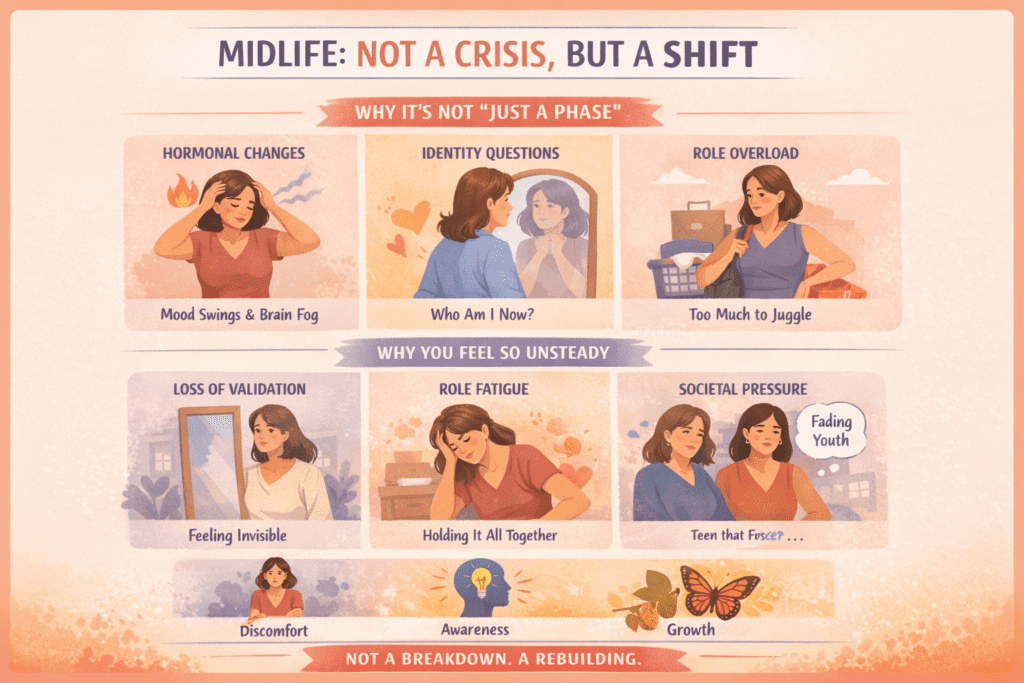
Hormonal and neurological recalibration
Estrogen doesn’t just affect reproduction. It plays a role in mood regulation, stress response, sleep, and cognition. As levels fluctuate during perimenopause and menopause, emotional stability can wobble.
This isn’t weakness. It’s biology.
Institutions like Psychology Today and Mayo Clinic acknowledge that hormonal shifts can amplify anxiety, irritability, and low mood – often before any physical symptoms become obvious.
Shifts in identity, meaning, and motivation
Midlife asks different questions than early adulthood. The goals that once drove you: achievement, approval, productivity, may lose their grip.
That loss of motivation isn’t apathy. It’s reorientation.
The psychological impact of accumulated life roles
By midlife, you’ve been many things to many people. Caregiver. Professional. Partner. Parent. The emotional labor adds up.
When those roles shift or loosen, it can feel like free fall. In reality, it’s the mind asking: Who am I without all this weight?
Why It Feels So Unstable
Loss of external validation and changing self-image
Praise fades. Attention shifts. And if your sense of worth was tied – at least partly – to performance or appearance, midlife can sting.
That doesn’t mean you’re invisible. It means the old mirrors no longer reflect who you are becoming.
Role fatigue and the emotional cost of “holding it all together”
Many women hit midlife exhausted from decades of competence. The pressure to stay strong, calm, and capable becomes unbearable.
Emotional instability here isn’t drama. It’s fatigue finally speaking.
Societal invisibility and internalized pressure
Psychology writers at Psychology Today note that women often internalize cultural messages equating worth with youth. When that validation disappears, self-doubt rushes in.
“Feeling unsteady doesn’t mean you’re falling — it means you’re shifting.”
Related reading: Moving From Coping to Stability During Menopause
If the emotional wobble feels tied to menopause changes, this piece walks through how to regain footing without forcing positivity.
The Growth Hidden in Discomfort
Disruption as an opening for awareness
Discomfort forces honesty. What no longer fits becomes obvious. That clarity can be unsettling – but it’s also powerful.
When uncertainty signals evolution, not decline
You’re not regressing. You’re outgrowing old structures. Growth doesn’t announce itself gently.
How emotional unease precedes clarity
Every meaningful recalibration includes a foggy middle. The discomfort is the bridge – not the destination.

How to Find Stability While Things Shift
Normalize the destabilization process
Stop treating emotional instability as a personal failure. It’s a normal response to compounded change.
Practice daily grounding for emotional regulation
Grounding isn’t about fixing feelings. It’s about anchoring yourself while they move through.
Simple practices – walking, breathwork, journaling – help the nervous system find rhythm again.
Rebuild meaning through micro-decisions and self-trust
You don’t need a five-year plan. You need small, honest choices that rebuild trust in yourself.
That trust is stability.
Tools and Support That Help
Journaling for emotional processing
Writing slows the noise. It creates space between sensation and story. This is where clarity starts.
A guided journaling tool designed to steady emotions and rebuild self-trust during transition.
Community and coaching support
Isolation amplifies instability. Shared language reduces it.
Connecting with others who understand midlife emotional changes normalizes the experience and softens the edges.
When therapy or medical guidance is useful
If anxiety, depression, or emotional volatility feel overwhelming or persistent, professional support matters. Organizations like The Menopause Society emphasize that emotional symptoms during midlife are common – and treatable.
Real Voices: Women Who Found Their Balance Again
“I thought I was unraveling. Once I understood what was happening in my body and brain, the fear eased.”
“Calling it a transition instead of a crisis changed everything. I stopped panicking and started listening.”
The relief isn’t instant. But reframing brings room to breathe.
Stability Doesn’t Mean Stillness. It Means Trust.
The midlife crisis myth collapses a complex, meaningful transition into a caricature of failure. That story doesn’t serve you.
Stability isn’t about going back to who you were. It’s about trusting yourself through change.
You’re not losing control. You’re adjusting to a new internal landscape.