






You’re not imagining the stress.
Menopause doesn’t just change your body – it changes how your nervous system processes everything. Sound, pressure, emotions, decisions. Things that once felt manageable suddenly don’t. And on top of that physiological strain, there’s something else quietly making it worse:
What you’ve been taught to believe about aging.
Menopause stress isn’t only hormonal. It’s cognitive. Cultural. Psychological. And when aging is framed as decline, loss, or invisibility, the stress response doesn’t just increase; it compounds.
This isn’t about mindset tricks or positive thinking. It’s about understanding why certain beliefs increase emotional load at the exact moment your system has the least capacity to carry it.
The Hidden Link Between Aging Beliefs and Menopause Stress
Stress during menopause isn’t random. It follows patterns.
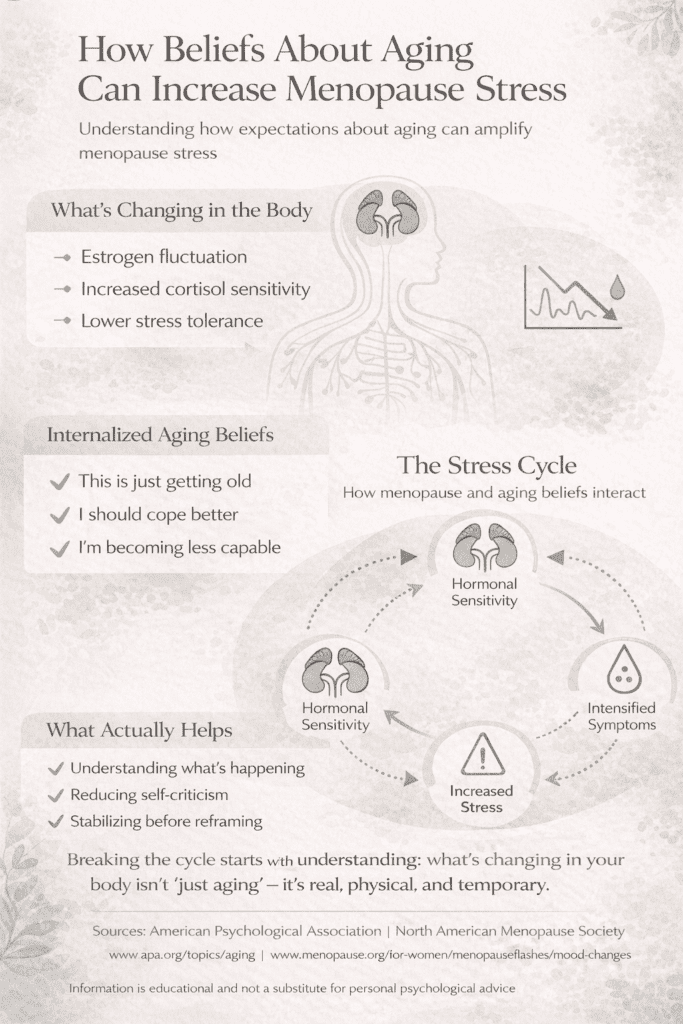
Hormonal shifts reduce your nervous system’s tolerance for overload. At the same time, long-held beliefs about aging start getting activated, often unconsciously. Thoughts like:
- I should be coping better than this.
- This is just what getting older feels like.
- I’m becoming less capable.
- I shouldn’t complain.
Those beliefs don’t sit quietly in the background. They influence how symptoms are interpreted, how emotions are judged, and how much pressure you place on yourself to “handle it.”
When stress hormones rise and self-criticism rises with them, the body doesn’t get relief. It gets stuck.
Research highlighted by the American Psychological Association shows that how people think about aging meaningfully affects stress response and psychological wellbeing — particularly during periods of physiological change.
The Science of Stress During Menopause
Menopause creates a perfect storm for stress sensitivity, even in women who’ve always been resilient.
How hormonal changes amplify emotional sensitivity
Estrogen doesn’t just regulate reproductive function. It also affects serotonin, dopamine, and GABA – neurotransmitters involved in mood stability, emotional regulation, and calm.
As estrogen fluctuates and declines:
- Emotional reactions can feel sharper
- Recovery from stress takes longer
- Anxiety can appear without an obvious trigger
- Tolerance for noise, conflict, and decision-making drops
This isn’t a personality change. It’s a nervous system under strain.
According to guidance from the The Menopause Society, fluctuating estrogen levels during menopause can heighten stress sensitivity and emotional reactivity – even in women with no prior anxiety history.
The cortisol–estrogen connection
Cortisol is your primary stress hormone. During menopause, cortisol regulation becomes less efficient. High stress leads to higher cortisol, which in turn worsens:
- Sleep disruption
- Anxiety
- Irritability
- Hot flashes
- Cognitive fog
Now add internal pressure, beliefs that frame menopause as weakness or aging as failure, and cortisol doesn’t get the signal to stand down.
The body stays on alert.
What We Believe About Aging and Why It Matters
Most women don’t consciously decide to fear aging. The beliefs are absorbed over decades.
Cultural scripts: “You’re past your prime”
Youth is rewarded. Aging is tolerated at best. That message doesn’t disappear at midlife; it gets louder.
When menopause arrives, it often feels like confirmation of a narrative you never agreed to but were trained to expect: decline, irrelevance, loss of desirability, reduced value.
Even women who intellectually reject those ideas often feel their emotional weight.
Internalized ageism and self-talk
Internalized ageism shows up as self-monitoring and self-correction:
- Don’t be dramatic.
- Other women have it worse.
- You should be grateful.
- This is just hormones – get on with it.
That kind of self-talk doesn’t calm the nervous system. It tightens it.
What research shows about aging mindset
Studies on aging perceptions consistently show that negative beliefs about aging are linked to higher stress levels, worse mental health outcomes, and increased symptom distress.
The belief itself doesn’t cause menopause symptoms, but it changes how threatening those symptoms feel, which directly affects stress response.

How Negative Beliefs Intensify Menopause Symptoms
Menopause symptoms aren’t experienced in isolation. They’re filtered through meaning.
Stress, shame, and symptom perception
Two women can experience similar physical symptoms and report vastly different levels of distress. The difference often lies in interpretation.
If symptoms are seen as:
- proof of decline
- evidence of weakness
- something to hide or minimize
the emotional burden increases. Stress rises. Symptoms feel harder to tolerate.
The “I should be fine” trap
Many women suppress emotional responses because they believe they should be coping.
That suppression backfires.
Unacknowledged stress doesn’t disappear, it shows up as irritability, exhaustion, anxiety, or shutdown.
“I’m functioning, but I’m not okay.”
That sentence alone explains a large portion of menopause stress.
What reframing actually does (when done correctly)
Reframing doesn’t mean pretending menopause is empowering. It means removing unnecessary threat.
When symptoms are understood as physiological – not personal failure – stress reduces. When stress reduces, symptoms often become more manageable.
Not gone. Just less consuming.
Common Myths That Feed Menopause Stress
These myths don’t just misinform. They increase pressure at the worst possible time.
“You’re too old to be attractive or desired”
This belief triggers shame and self-surveillance. It narrows identity and increases anxiety around body changes and intimacy.
Stress rises. Confidence drops. Connection becomes harder, not because desire disappears, but because fear takes over.
“Your best years are behind you”
This narrative creates grief before anything has actually been lost. It frames change as ending rather than shifting.
Grief without validation becomes stress.
“You just have to push through”
Pushing through might work short-term. Long-term, it teaches the nervous system that distress will be ignored.
That’s not resilience. It’s overload.
Shifting the Story: From Decline to Understanding
This isn’t about replacing one narrative with a prettier one. It’s about accuracy.
Self-compassion as regulation, not positivity
Self-compassion isn’t motivational language. It’s physiological safety.
When you stop arguing with your symptoms, the stress response eases.
Grounding practices that actually stabilize
Stabilization comes from:
- predictable routines
- reduced cognitive load
- adequate sleep support
- realistic expectations
Not from pushing for growth while the system is dysregulated.
Awareness without denial
Understanding what’s happening in your body allows you to respond instead of react. That alone lowers stress.

Practical Tools to Calm the Mind and Reset Beliefs
Tools don’t fix menopause. They reduce load.
Cognitive reframing (without gaslighting yourself)
Useful reframes sound like:
- This reaction makes sense right now.
- My nervous system is sensitive – not broken.
- I don’t need to solve this today.
Not:
- Everything happens for a reason.
- This is a gift.
- I should be grateful.
Support that doesn’t minimize
Therapy, support groups, and education spaces that treat menopause as a legitimate physiological transition – not a mindset issue – reduce isolation and stress.
Evidence-based support options
Sleep support, stress-regulating supplements, and gentle nervous-system practices can help ease the load. Used appropriately, they support stabilization – not transformation.
(If you want a deeper explanation of why understanding comes before change, this connects directly to Why Understanding Menopause Comes Before “Rewriting” It.)
Why Understanding Yourself Comes Before Rewriting Your Story
You don’t rewrite a story while you’re still in the middle of an untreated crisis.
Menopause stress doesn’t respond well to pressure. It responds to clarity.
Stabilization first. Support second. Strength comes later; if and when it’s available.
You Are Not the Problem, the Narrative Is
Your stress isn’t a failure of attitude.
It’s what happens when a hormonally sensitive nervous system is asked to carry physiological change and decades of cultural pressure at the same time.
When those beliefs are questioned – not replaced, just examined – the stress load lightens.
Not because menopause becomes easy.
But because you’re no longer fighting yourself while going through it.